About
The Faculty of Medicine at the University of Geneva is launching its first interdisciplinary research hackathon on digital phenotyping of mental health at Campus Biotech. In a focused 32-hour format, clinicians, researchers, engineers and around 50 Master’s and PhD students form mixed teams, build early prototypes, and shape project outlines designed to become fundable research projects.
Why this matters
- Digital phenotyping is emerging as a major frontier in mental health research, but progress depends on stronger connections across clinical, technical and methodological communities.
- A compact sprint makes it possible to move rapidly from challenge framing to proof of concept, while surfacing collaborations that would rarely emerge through conventional academic channels.
- AI has lowered the barrier to prototyping. A small team can now build something working in a weekend that would have taken months — so the bottleneck has shifted from implementation to problem framing and team assembly.
- This is not a standalone event. It is a mechanism to create communities, seed projects, and accelerate a pipeline of proposals for grants and philanthropy.
How it runs
Before — May to October
Challenge shaping from needs submitted by the community, preparatory workshops, and team recruitment.
During — 32 hours
Kickoff, challenge pitches, team formation, three hacking blocks with mentoring, and public final presentations.
After — November to March
Follow-up, grant coaching with the Research & Grants Office, and conversion of the strongest projects into submissions.
The challenges
The hackathon will feature six challenges revolving around digital phenotyping. Specific challenges are being shaped by the advisory board from needs submitted by the community, and will be announced in September 2026.
Theme: digital phenotyping
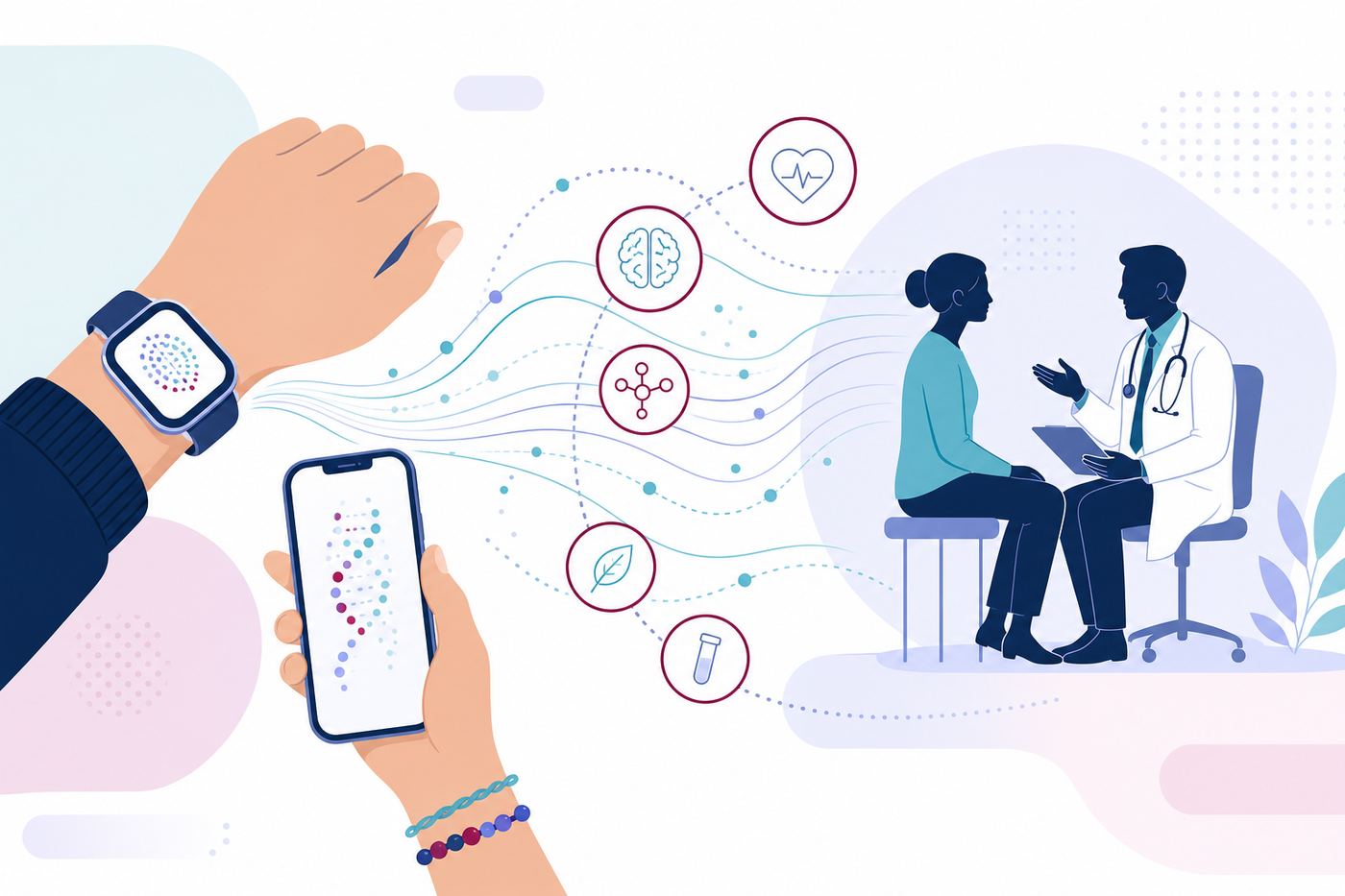
All challenges connect to digital phenotyping — the use of digital devices (smartphones, wearables, cameras, sensors) to capture continuous, objective measures of human behaviour and physiology in naturalistic settings. The theme spans clinical, research and technical problems.
Three pillars
Clinical
Patient-facing digital phenotyping applications — psychiatric monitoring, neurological biomarkers.
Research
Analytical and scientific questions enabled by digital phenotyping data.
Platform
Technical infrastructure for collecting, processing and analysing digital phenotyping data.
How challenges are designed
- Precise and catchy. Every challenge has a clear, concrete problem statement that can be tackled in the time available. No vague themes, no open-ended explorations.
- Postdoc-led. PIs provide endorsement and domain expertise, but the challenge runner is a postdoc who owns the problem, prepares the data and guides the team.
- Mixed teams. Teams form from participants who sign up and express interest — challenge owners cannot pre-select their whole team. This is what forces cross-lab, cross-discipline mixing.
- Wildcard invites. Each challenge owner may invite up to two external participants who bring complementary expertise.
- Actionable deliverables. Each challenge defines concrete outputs: a working prototype, a validated pipeline, an analysis notebook, a proof-of-concept application.
- Follow-up pathway. Challenges are designed so that successful outputs can evolve into research projects, grant proposals or open-source tools.
Challenges are finalised over the summer and announced in September 2026.
What it builds
- Builds interdisciplinary research communities across FacMed, Campus Biotech and partner institutions.
- Kick-starts the digital phenotyping facility at FCBG by connecting real users, real problems and early prototypes from the outset.
- Engages philanthropy from the onset, through final presentations and early alignment around impact narratives.
- Offers micro-learning certificates for students, linked to the preparatory workshops and hackathon participation.
Expected outputs
- New interdisciplinary teams and challenge communities that continue beyond the event.
- Tangible team artifacts: a short repo, a demo, a prototype or proof of concept, and a structured project outline.
- A shortlist of projects ready for post-event follow-up with advisory and grants support.
- A pipeline of research proposals for SNSF, Horizon Europe, philanthropy and other targeted funding routes.
Organisers and ecosystem
Organised by the Digital Phenotyping Platform Committee at the UNIGE Faculty of Medicine. Core ecosystem: Faculty of Medicine (UNIGE), Campus Biotech / FCBG, Synapsy, CISA, EPFL, and the Research & Grants Office. Wider collaborative environment: HUG, CHUV/CIBM, and other Swiss academic and clinical partners.